Daily Movement
Walking and Weight Balance: What the Evidence Actually Shows
Eleanor Whitfield
·
The fitness industry's frame of reference narrows what most people consider to be physical activity. When activity is defined by sessions, equipment, and heart-rate thresholds, the extraordinary quantity of movement embedded in domestic life becomes invisible — and therefore uncounted. That invisibility has a cost.
Research into daily energy expenditure has long identified a substantial contribution from what researchers classify as low-intensity domestic physical activity: tidying, cooking, carrying, gardening, climbing stairs within the home. In studies that use accelerometry to track total body movement rather than formal exercise sessions, this category of activity emerges as a consistent and substantial component of total daily energy expenditure.
A person who spends forty-five minutes cooking a meal from scratch, carrying groceries from a distance, vacuuming three rooms, and hanging laundry will typically have accumulated a metabolically significant quantity of movement — often equivalent to or exceeding a moderate-pace walk of similar duration. The difference is that these activities carry no cultural or psychological designation as exercise, and so they are neither logged nor valued.
This classification problem has consequences. When household activity goes uncounted, individuals who are deeply active in their domestic lives frequently believe themselves to be sedentary. This misperception can generate unnecessary anxiety about fitness, or lead to the adoption of formal exercise programmes that ultimately prove unsustainable precisely because they add to an already substantial movement load.
The first practical step in understanding household activity as movement is to count it. This is not merely a psychological exercise — it has measurable behavioural effects. Research on self-monitoring and physical activity consistently finds that individuals who track a broader range of activity (including domestic tasks) report higher levels of perceived activity, greater satisfaction with their lifestyle, and, in some studies, increased activity levels overall.
The mechanism is partly motivational: when domestic activity is counted as movement, the individual is reinforced for the activity they are already doing, rather than only for formal exercise sessions they may be failing to attend. This shifts the default orientation from deficit (I didn't go to the gym) to surplus (I accumulated significant movement today), which tends to support rather than undermine ongoing activity.
Practically, this reframe involves using a step counter or accelerometer without filtering to exercise-only sessions, keeping a simple tally of significant domestic tasks completed each day, and establishing a baseline of habitual household activity before adding formal exercise. For many individuals, this baseline review reveals a movement picture considerably more active than their self-concept had suggested.
"When household activity goes uncounted, individuals who are deeply active in their domestic lives frequently believe themselves to be sedentary."
Beyond counting existing household activity, there are well-documented strategies for increasing its metabolic contribution without adding dedicated exercise sessions. These strategies operate on the principle of intentional friction — deliberately choosing the more movement-demanding option within domestic tasks that are going to be completed regardless.
Carrying shopping in one bag at a time rather than two. Using the upstairs bathroom during the day rather than the ground floor one. Standing while speaking on the phone. Washing dishes by hand rather than loading the dishwasher immediately. These are not exercises; they are small recalibrations of habitual domestic behaviour that collectively produce a measurable increase in daily movement volume.
Studies on intentional friction strategies in sedentary adults consistently show modest but consistent increases in daily step count and total movement volume following the adoption of even two or three such behavioural shifts. Crucially, these increases are typically sustained over longer follow-up periods than gym-based exercise adherence, because they are embedded in existing routines rather than being additions to them.
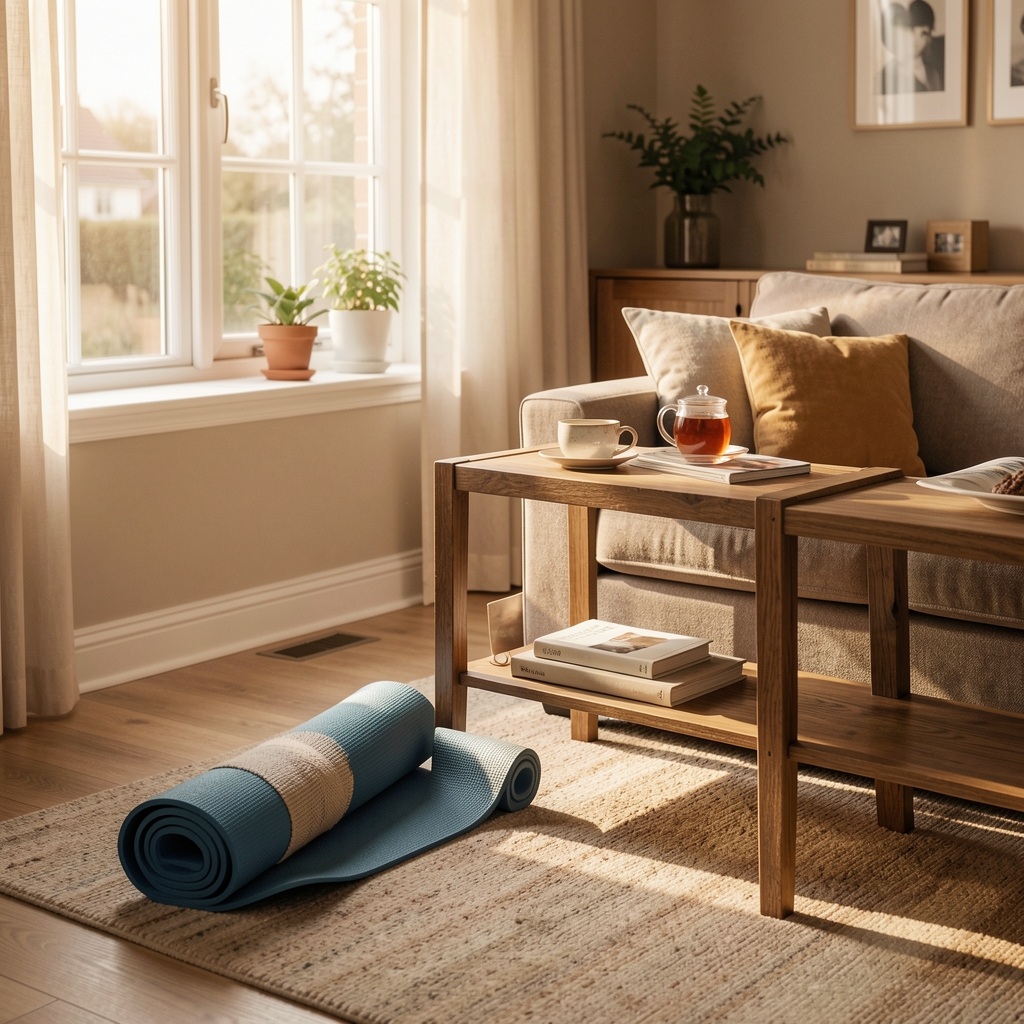
Beyond the movement embedded in routine tasks, the home environment offers a complete setting for deliberate bodyweight movement that requires no equipment and can be integrated into existing daily rhythms. Bodyweight squats while waiting for the kettle, standing calf raises while reading, wall push-ups during a work break — these micro-movement patterns are well-documented in exercise science as contributors to daily movement volume.
Their contribution to energy balance is real but modest when considered in isolation. Their primary value, in the context of a sustainable movement practice, is different: they establish and maintain the movement habit, and they ensure that the body's movement system remains engaged throughout sedentary periods. The metabolic benefit of regularly interrupting sitting with brief bodyweight movements is increasingly well-supported in the literature on sedentary behaviour.
This matters because prolonged uninterrupted sitting has distinct adverse associations with metabolic markers, separate from and in addition to the effects of overall daily activity level. An individual who exercises for thirty minutes but then sits continuously for the remaining fifteen waking hours occupies a different metabolic position from one who is active in shorter bursts throughout the day. Domestic bodyweight movement is one of the most practical mechanisms for achieving that distribution.
What distinguishes household activity from formal exercise as a sustainable movement strategy is its rhythm. Formal exercise requires a session — a discrete commitment of time, equipment, motivation, and recovery. Household activity is diffuse, continuous, and embedded in the existing rhythm of the day. It asks nothing extra of the individual's schedule; it is already there, waiting to be counted and valued.
The low-intensity exercise rhythm that emerges from a conscious engagement with domestic movement is one of the more sustainable approaches to weight management available to non-athletic adults. It does not require the overcoming of exercise-resistance or the scheduling of a session that competes with other commitments. It requires only a shift in perception: a willingness to recognise that the home is already a movement environment, and that the activities of ordinary life already constitute a genuine contribution to physical wellness.
The evidence base for this position is not as mature as the evidence for structured exercise — it is a younger area of research, and many of its key studies are observational rather than experimental. But the direction is consistent, and the practical implications are straightforward enough to act on without waiting for further confirmation: move more in the domestic hours, count what you already do, and build from there.

Tobias Marsden is a guest contributor to Oravelin Journal, writing on domestic movement patterns, metabolic research, and the overlap between everyday life and functional fitness. He brings an observational, research-informed perspective to the question of what counts as movement.
Read more articles →